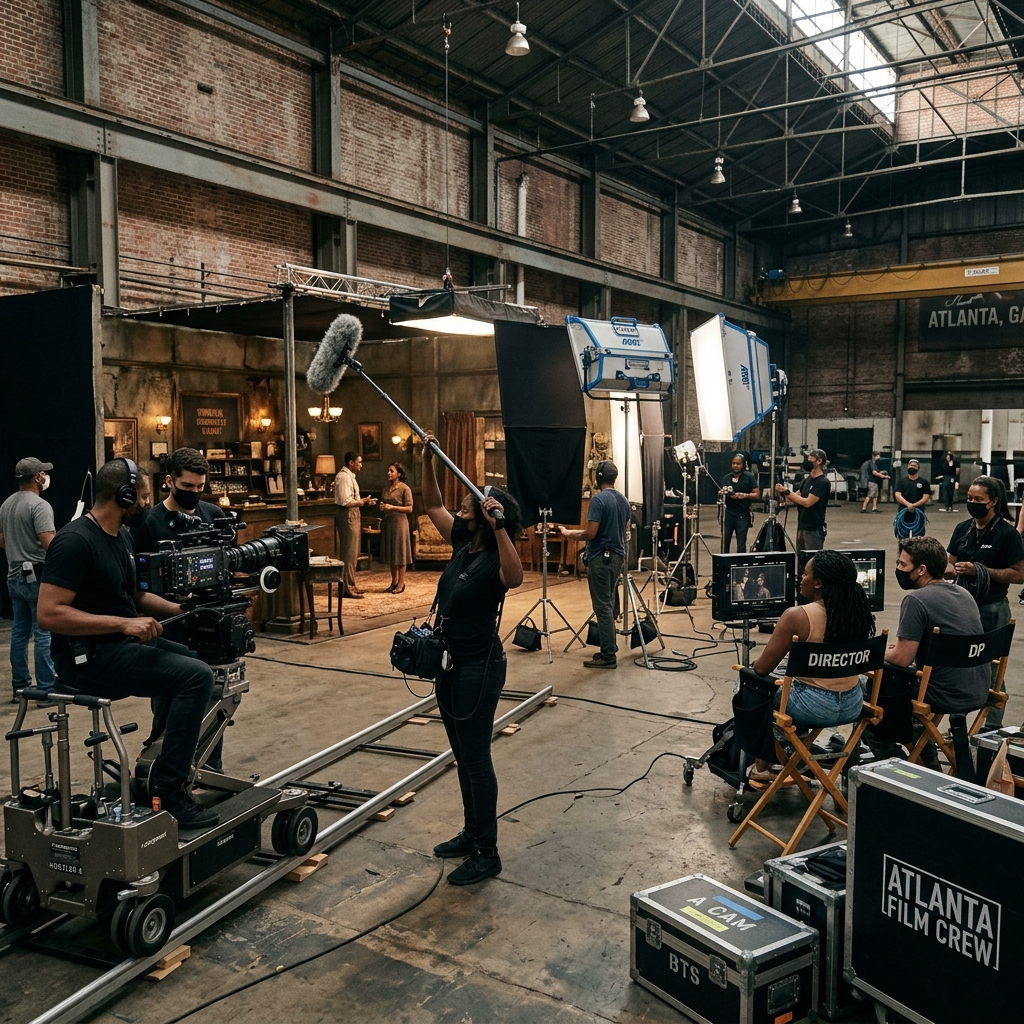

Georgia’s film and TV production industry is in the middle of a strong rebound — but the growth is happening outside Atlanta for the first time in a generation.
The state booked $4.4 billion in film production spending in the first half of 2026, up 22 percent from the same period last year, according to numbers released by the Georgia Department of Economic Development on Tuesday. The full-year 2026 number is on track to exceed the all-time high set in 2022.
But the metro Atlanta share of that spending has fallen to 54 percent — the lowest since 2014 — as new sound stages and tax-incentive packages have opened up Savannah, Augusta, and Columbus to major productions.
What’s happening in Savannah
The biggest shift is in Savannah, which has emerged as the metro Atlanta of the Georgia film industry’s east coast. The city has six new sound stages under construction in 2026, bringing the total active capacity in the Savannah area to about 28 stages — roughly half of metro Atlanta’s 56.
Two of those new Savannah stages are part of a $280 million complex being built by EUE/Screen Gems, the Atlanta-based production company that has long operated the largest stage complex in the Southeast. The complex, on the site of a former steel mill on the Savannah River, is expected to be fully operational by spring 2027.
“We’ve outgrown the Atlanta footprint. The talent is in Atlanta, but the stages are moving to where the land and the incentives are.”
— EUE/Screen Gems president
What’s happening in Augusta and Columbus
Augusta is a smaller but rapidly growing market. The Augusta Film Office, founded in 2023, has booked 14 productions in the first half of 2026 — more than the city had in the prior three years combined. Most of those productions are smaller (commercials, music videos, indie features), but two are mid-budget streaming series.
Columbus is the newest entrant. The city opened its first dedicated sound stage in March, a $42 million facility funded by a public-private partnership. The first major production — a limited series for a major streaming platform — is expected to begin filming there in August.
What this means for Atlanta
Atlanta remains the production capital of the Southeast, and probably will for the foreseeable future. The metro has more sound stages, more crew, more post-production facilities, and more support services than anywhere else in the region.
But the share-of-state-spending decline is real, and it’s driven by three things:
- Cost. Atlanta’s cost structure has gotten expensive relative to Savannah and Augusta. Productions that can be done outside Atlanta increasingly are.
- Tax incentives. The Georgia Entertainment Industry Tax Credit (a 30 percent transferable credit) is the same statewide, but Savannah and Augusta are offering additional local incentives to attract productions.
- Capacity. Atlanta’s stages are full. Producers who can’t get the time they need in Atlanta go to Savannah, where stages are more available.
“We don’t see this as Atlanta losing — we see this as Georgia winning. The state’s film industry is bigger than any one city. But Atlanta needs to figure out how to stay at the center of it.”
— Georgia Film Office director
What’s at stake
Film and TV production is a major industry for metro Atlanta — it supports roughly 35,000 direct jobs and another 60,000 indirect jobs, and contributes more than $1.2 billion in annual tax revenue to the state. The industry’s growth outside Atlanta doesn’t directly threaten those Atlanta-based jobs, but it does signal that the city can’t take the cluster for granted.
“If you’re a producer choosing between filming in Atlanta and filming in Savannah, and the costs are similar, you might as well film in Savannah. The city’s pitch has always been ‘we have everything you need here.’ If that’s no longer true for the biggest productions, we have a problem.”
— A senior line producer who has worked in both markets
Aisha Bell covers business and the economy for WACN 21. Reach her at abell@wacn21.com. Kira Tomlinson covers arts and culture for WACN 21. Reach her at ktomlinson@wacn21.com.