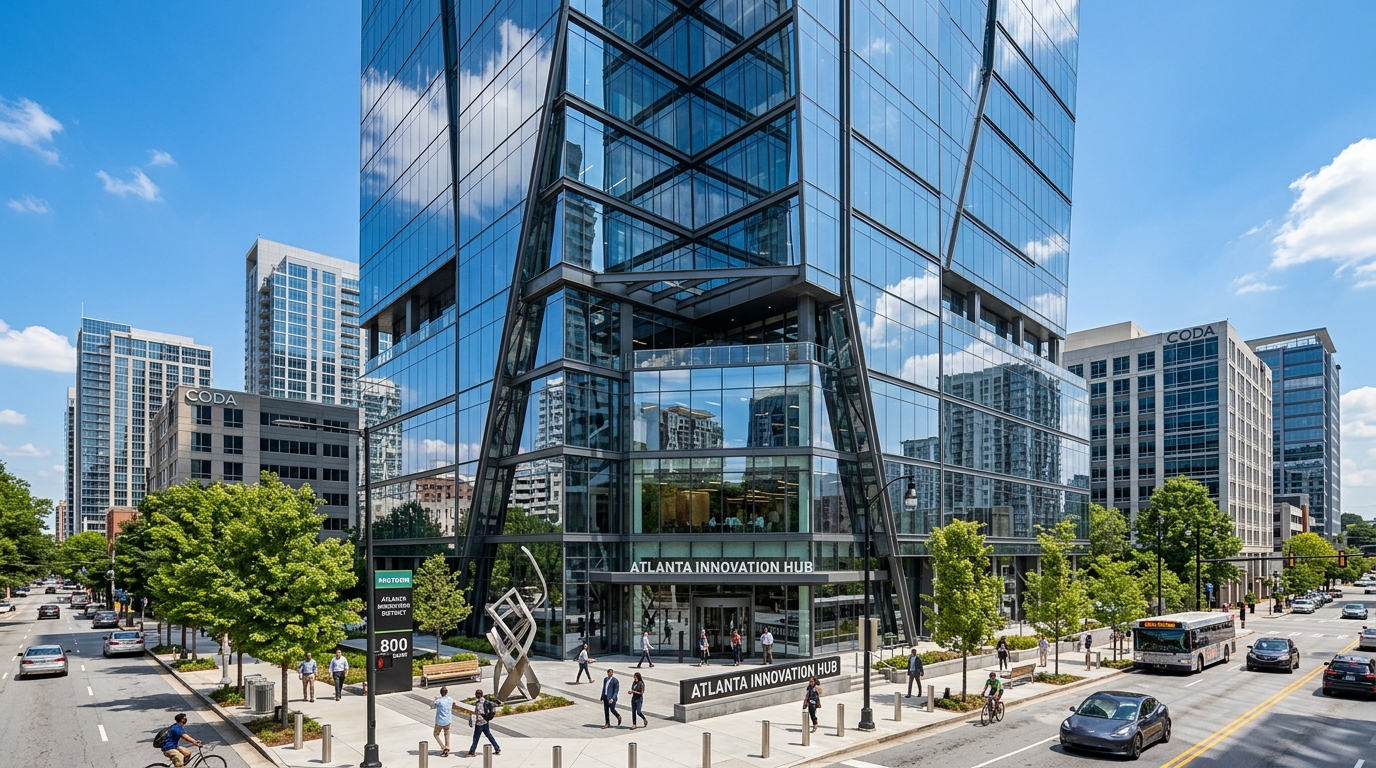

ATLANTA — The cranes rising above Midtown Atlanta tell a story that goes far beyond construction. Tech Square, the innovation district anchored by Georgia Tech, is entering its next phase of expansion — and the numbers behind it underscore why Atlanta is increasingly mentioned alongside Austin, Boston, and the Bay Area as a top-tier technology hub.
A Record Year for Investment
In 2025, metro Atlanta attracted $1.2 billion in venture capital, much of it flowing into startups and established firms clustered around Tech Square and the broader Midtown corridor. The investment surge reflects a city that has moved well beyond its traditional strengths in logistics and hospitality to compete aggressively in sectors that define the modern economy.
Atlanta now ranks among the nation’s leading cities in fintech, health information technology, and cybersecurity — three fields where local companies and Georgia Tech research labs have built deep expertise and a pipeline of talent that recruiters increasingly prize.
Aerospace Engineering Gets a Boost
A major catalyst for the district’s next chapter is an $88 million investment funded jointly by the state of Georgia and Delta Air Lines to construct a new aerospace engineering building on the Georgia Tech campus. The facility will expand the university’s capacity to train engineers and conduct research in advanced materials, propulsion systems, and autonomous flight — fields that align squarely with Delta’s long-term technology strategy and the state’s broader push to attract aerospace and defense employers.
The building is expected to strengthen an already robust education-to-industry pipeline that has become one of Atlanta’s most potent economic development assets. Georgia Tech graduates roughly 4,000 engineering and computing students annually, and a significant share remain in metro Atlanta to launch careers or found companies.
The Innovation District Model
Tech Square operates on the innovation district model that cities worldwide have tried to replicate — concentrating research institutions, corporate R&D offices, startup incubators, and venture capital firms within walkable urban blocks. The proximity is deliberate: it accelerates the informal collisions between researchers, entrepreneurs, and investors that often spark new ventures.
Major corporations including NCR Voyix, Honeywell, Cisco, and Anthem maintain innovation centers in or near Tech Square, drawn by access to Georgia Tech talent and the collaborative ecosystem that the district has cultivated over the past decade.
What’s Next
With construction underway on several new mixed-use and lab buildings, Tech Square’s footprint is expected to roughly double over the next five years. City and university officials have signaled that future phases will emphasize sustainability, affordable housing for graduate students and early-career workers, and improved transit connections — including potential coordination with MARTA’s evolving bus and rail network.
For Atlanta, the stakes are high. The city’s ability to sustain its technology momentum depends on whether it can continue to attract top talent and capital while managing the cost-of-living pressures that have squeezed rival markets.
Devon Patterson covers investigative reporting and business for WACN 21. Reach them at dpatterson@wacn21.com.