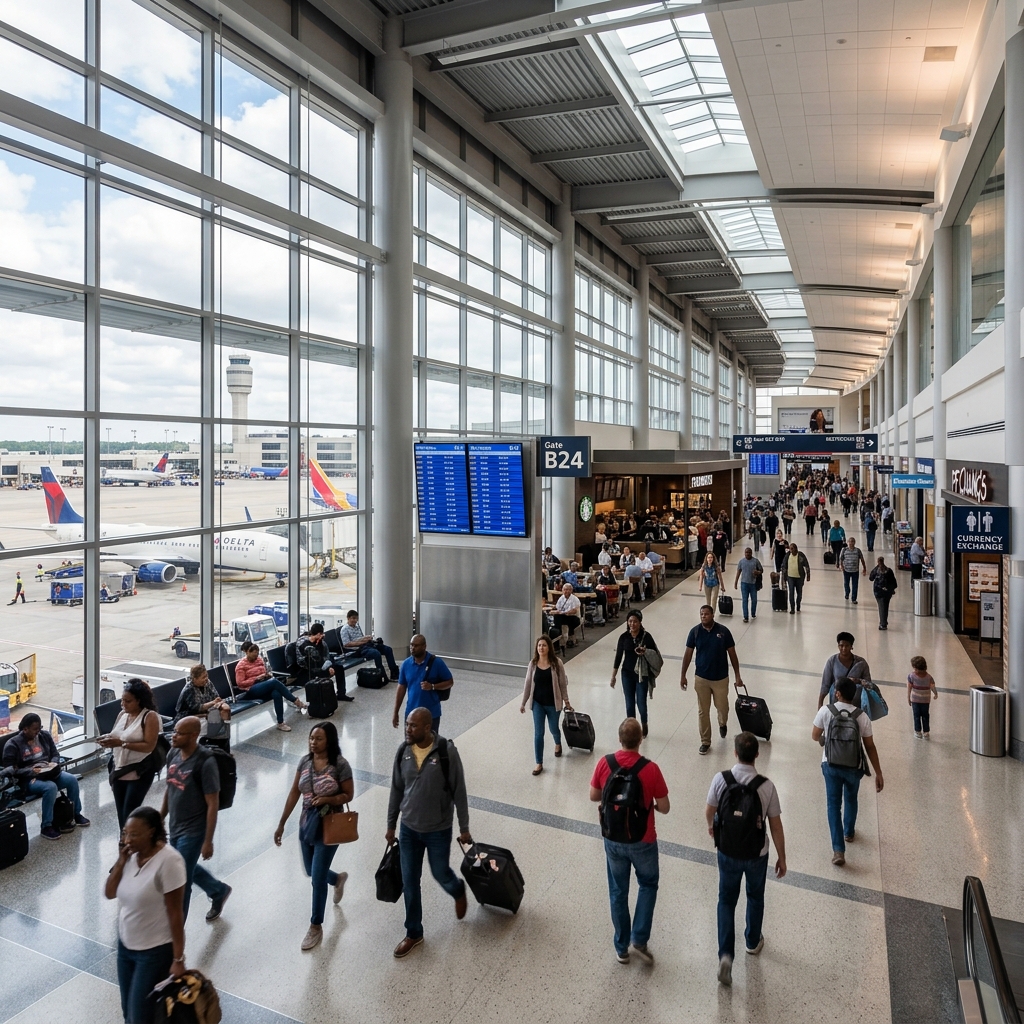

ATLANTA — The Federal Aviation Administration is reviewing a close call Monday between two Delta Air Lines flights at Hartsfield-Jackson Atlanta International Airport after an arriving crew aborted its landing when another aircraft was on the runway.
According to Atlanta News First (WANF/CBS 46), Delta Flight 1568 from Pittsburgh to Atlanta executed a go-around after the pilot saw another plane on the runway. Air traffic control audio cited in that report showed a controller telling the pilot the other aircraft would move in time; the arrival crew still went around and ended up about 1,800 feet from Delta Flight 2472, which had just taken off for Rochester, New York.
What Delta said
Delta told Atlanta News First that its crews are trained to handle unusual situations. Flight 1568 carried 150 customers and six crew members, maneuvered around the traffic, and later landed safely, the airline said in the same report.
The carrier also said it would “fully cooperate with authorities on any review” and that “Safety remains at the core of everything we do,” according to the statement language published by Atlanta News First. CNN contributed reporting to that package.
No injuries were reported in the available local coverage. The FAA had not publicly posted a final probable-cause finding as of the evening news cycle; go-around events often remain under review for days or weeks while radar tracks, cockpit voice data where applicable, and controller communications are examined.
Why go-arounds happen
A go-around is a standard aborted-landing procedure: power up, climb away, and re-enter the pattern or a published missed-approach path. Pilots are trained to execute one whenever the runway is not clear, the approach is unstable, or spacing with other traffic is uncertain — even if a controller expects the conflict to clear.
Hartsfield-Jackson is among the world’s busiest airports. Parallel operations, tight departure banks, and summer weather already demand precise sequencing. Close calls that stay well short of a collision still draw FAA scrutiny because they test whether spacing standards, phraseology, and pilot decision-making worked as designed.
Travelers who hear “go-around” from the cabin should treat it as a trained safety maneuver, not an emergency landing. The aircraft typically climbs, circles or holds as directed, and attempts another approach when the path is clear.
What happens next
- The FAA review will examine separation, runway occupancy, and communications.
- Delta’s internal safety processes run in parallel with the federal look.
- Any operational changes — spacing buffers, phraseology reminders, or training notes — would come after investigators finish the fact pattern.
WACN 21 will update if the FAA or Delta release additional official findings. Until then, the verified public record is the Atlanta News First account of the Monday event, the airline’s safety statement, and the confirmation that Flight 1568 landed safely after the go-around.
Metro Atlanta residents who fly frequently through ATL already know delays and weather holds; this episode is a reminder that the busiest days still depend on crews willing to abandon a landing when the picture is wrong.