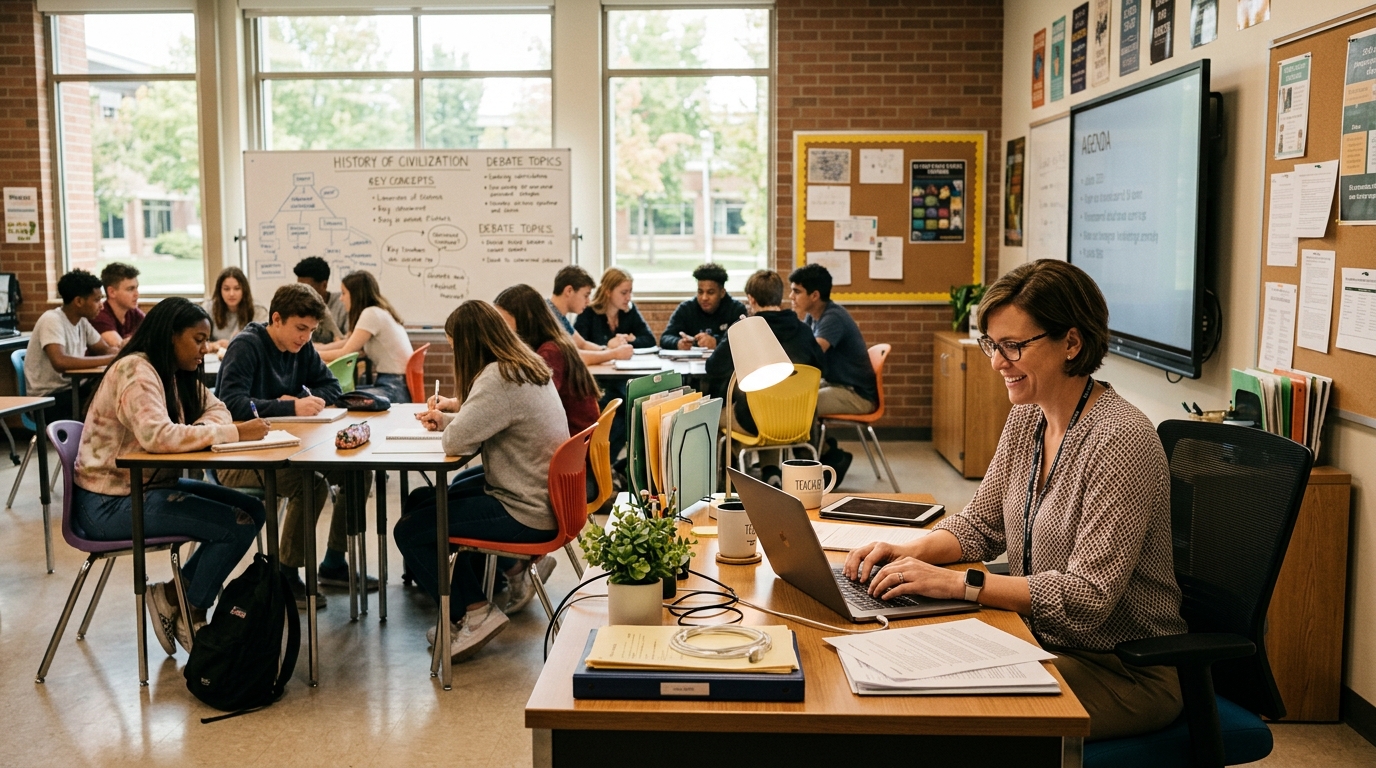

Here is a fact that should both encourage and unsettle Georgia’s education leaders: more than half of the state’s teachers are already using artificial intelligence tools to plan their lessons, draft assignments, and differentiate instruction for their students. They are doing this largely on their own, without statewide guidance, uniform training, or a clear policy framework.
That’s the reality on the ground. And it demands a response.
The Quiet Revolution in Georgia Classrooms
We are not talking about some far-off future where robots replace teachers. We are talking about right now — about the high school English teacher in Cobb County who uses an AI assistant to generate reading comprehension questions tailored to three different skill levels. The middle school math teacher in Bibb County who feeds her learning standards into a chatbot and gets a week’s worth of warm-up problems in minutes. The special education coordinator in DeKalb County who uses AI to draft individualized education plan language, freeing up hours she once spent on paperwork to spend with her students instead.
These educators are not waiting for permission. They are solving real problems with the tools available to them, and the results — by their own accounts — are overwhelmingly positive.
The benefits are hard to argue with. AI-powered lesson planning saves teachers meaningful time, often several hours per week that can be redirected to direct instruction, mentoring, and the relational work that no algorithm can replicate. It enables differentiated instruction at a scale that was previously impossible for a single teacher managing 30 or more students. And it lowers the barrier for newer educators who may lack the deep curriculum libraries that veteran teachers have built over decades.
This is, on balance, a good thing. We should be encouraged that Georgia’s teachers are early and enthusiastic adopters of a technology that has genuine potential to improve outcomes for students.
The Risks We Cannot Ignore
But adoption without guardrails is a gamble. And the stakes — we are talking about children’s education — are too high for a roll of the dice.
The concerns are real and well-documented:
- Academic integrity. If teachers use AI to generate assessments, what prevents students from using the same tools to generate answers? The line between AI as a teaching aid and AI as a shortcut is blurry, and it requires clear, enforceable policies.
- Over-reliance on AI-generated content. Not all AI output is accurate. Large language models can produce plausible-sounding material that contains factual errors, cultural biases, or developmentally inappropriate content. Teachers need the training to evaluate AI output critically — not just accept it at face value.
- Equity gaps. Teachers in well-resourced districts are far more likely to have access to high-quality AI tools, professional development, and technical support. Without deliberate state-level intervention, AI adoption risks widening the already significant achievement gaps between affluent and underserved communities.
- Data privacy. Many AI tools require users to input student-related information. Without clear guidelines on which platforms are approved and how data is handled, the privacy of Georgia’s students could be compromised.
What the State Needs to Do
We are not calling for a ban. We are not calling for caution so extreme that it stifles innovation. We are calling for leadership.
The Georgia Department of Education should move swiftly to:
- Establish a statewide AI policy framework for K-12 classrooms that provides clear guidelines on approved tools, acceptable use cases, and data privacy requirements.
- Fund professional development specifically focused on AI literacy for teachers — not just how to use the tools, but how to evaluate their output and integrate them responsibly.
- Create an equity-focused AI access initiative that ensures teachers in Title I schools and rural districts have the same access to high-quality AI tools as their peers in wealthier systems.
- Engage teachers, parents, and students in the policymaking process. The people closest to the classroom should have a seat at the table.
The Window Is Closing
The technology is not going to slow down to wait for policymakers. Every month that passes without statewide guidance is another month in which individual teachers and districts are making consequential decisions in isolation — decisions that affect curriculum quality, student privacy, and educational equity across the state.
Georgia’s teachers have shown us they are ready. They are already doing the work. The question is whether the state’s leadership will step up to support them — or leave them to navigate this transformation alone.
We believe the answer should be obvious.
Lena Bishop is the opinion editor at WACN 21 News. Reach her at lbishop@wacn21.com.