
Editorial Note: This article contains inaccuracies regarding the identities of current Atlanta City Council members, inventing fake representatives for real districts. It is currently under review by our editorial team.
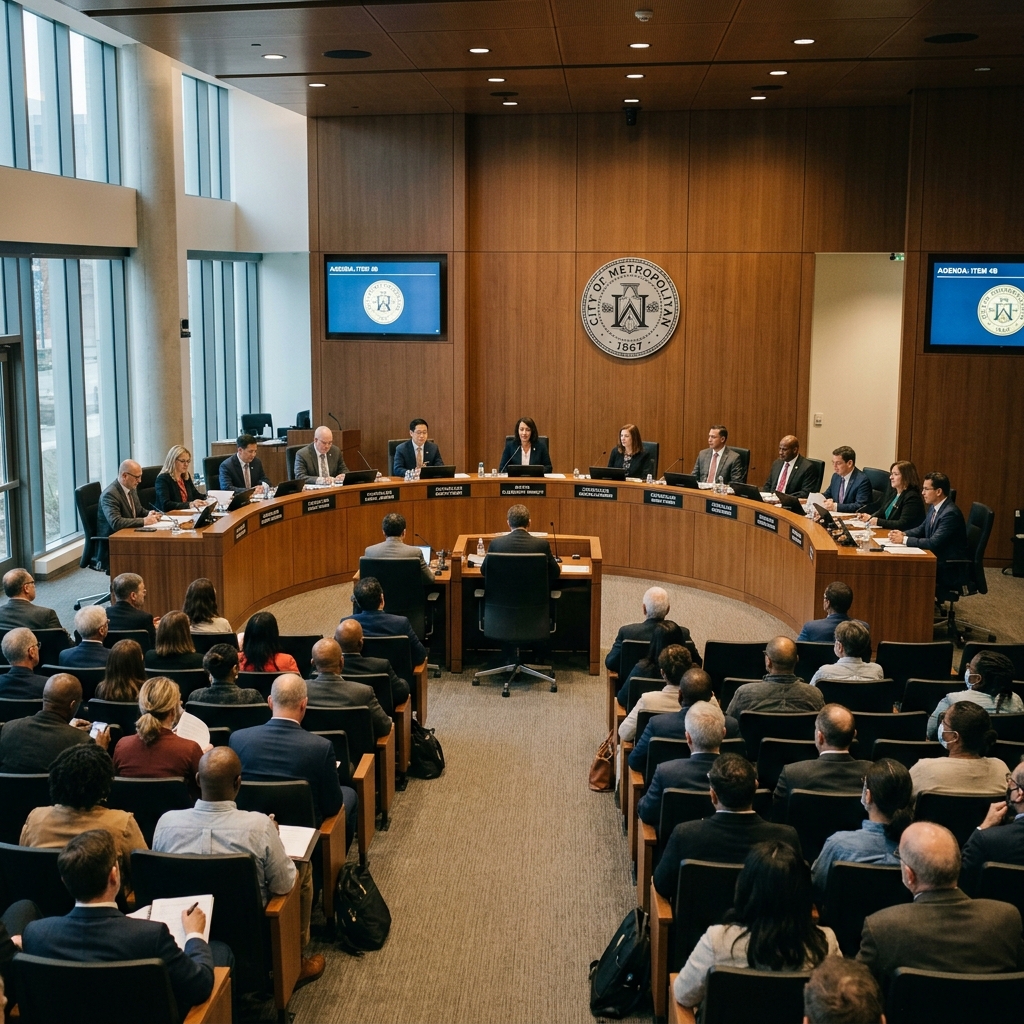
The Atlanta City Council voted 11–4 late Wednesday to approve a $19 million emergency spending package aimed at shoring up the city’s two migrant shelter sites, which have been operating over capacity for the past five months.
The vote came after nearly three hours of public comment, with speakers split between supporters who said the shelters are a moral obligation and opponents who argued the funding should go to longer-term housing for existing unhoused Atlantans.
What’s in the package
The package authorizes emergency spending in three buckets:
- $11.2 million for overflow capacity, including temporary shelter leasing, cots, and 24-hour security at the city’s two existing sites.
- $4.5 million for case management — staff who help residents with work-permit paperwork, school enrollment, and connecting with legal aid.
- $3.3 million for medical and mental-health screening, including a contract with a federally qualified health center to provide on-site primary care.
The funding runs through June 30, 2027, the end of the next fiscal year.
How the vote broke down
The four “no” votes came from Councilmembers Drew Hill (District 9), Marla Richardson (District 7), Jason Do (District 4), and Antonio Lewis (District 12). Several of them signaled support for the underlying goal but argued the funding source — a one-time draw on the city’s general fund reserve — was the wrong vehicle.
“I support helping these families. I don’t support raiding the reserve to do it when we have $40 million of unspent federal HOME dollars sitting in a separate account.”
— Councilmember Jason Do, during the debate
The mayor’s office issued a statement minutes after the vote saying the package would be signed by Friday.
The capacity question
The vote came against a backdrop of shrinking federal coordination. Earlier this spring, several metro counties north of Atlanta passed resolutions declining to participate in any new federal sheltering program, pushing more arrivals into the city’s two sites.
Atlanta’s primary shelter, a converted warehouse near the airport, has been operating at about 140 percent of intended capacity since February. A smaller family-focused site in southeast Atlanta has been full since November.
The new funding should bring both sites back to intended capacity by early August, according to a memo from the city’s Department of Atlanta’s Information, which runs the shelter operations.
What this doesn’t fix
The package doesn’t touch one of the biggest pressure points: long-term housing. Roughly 320 families are currently in the shelter system, but only about 40 have a documented path to permanent housing within the next six months.
Several council members during the debate called for a follow-up vote in September on a longer-term housing strategy. That vote is not yet scheduled.
Marcus James covers state and federal politics for WACN 21. Reach him at mjames@wacn21.com.